Friday, April 26, 2024

Audio Animation (A Chronological Survey)

Before we move on, I'd like to expand on the idea of there being an audio animation canon. What follows is just a sketch. A test run. But even a woefully incomplete charting of this history may be of interest. I've organized my thoughts in terms of "phases" because different generations have discovered different ways of animating. Of course, there's always diversity within a generation. But the trailblazers who emerge during a certain era tend to share an underlying angle of approach. In the next few posts, we’ll investigate more specific listening principles. But for now, an attempt at taking in the big picture...

Free Flowing Environments: The First Phase

The early masterpieces of audio animation were fever dreams of high modernism. It was during this epoch that the inchoate tradition was least tempered by compromise with conventional notions of musicality. Motion was wild and utterly free. Flurries of audio shot at hyperspeed across vast distances; disjointed audio fragments acted as
flashing vision-sequences; sounds cascaded up and down, chirped melodiously in mechanical birdsong, and slept in slowly undulating drones, like waves on an alien ocean. The music has a visceral pull, but it’s a physicality that takes you outside your own body. The listening experience is like astral projection or soul flight, disembodied travel through elemental and supernatural forces. And in the space age imagination, this sort of travel can take you far beyond Earth's atmosphere. As in prehistoric cave paintings, the cosmos is foregrounded while the human subject is barely there.  

The simplest form of audio animation is the sound effect. As lofty and uncompromising as this epoch was, its roots were in a more utilitarian notion of diegetic sound. Pierre Schaeffer had years of experience creating effects for radio by the time he formally began the project of musique concrète, and his early collaborations with Pierre Henry often reflect the narrative and imagistic beginnings of his work with sound. The BBC Radiophonic Workshop followed a similar trajectory, with origins in simple effect-generation evolving into more elaborate musical projects. In America, Tod Dockstader designed sounds for
Tom and Jerry during his fledgling years as a composer. Louis and Bebe Barron were also heavily involved in film; their experiments blurred the line between soundtrack and sound effect.

If any of the earliest institutions appeared totally removed from the foley aspect of electronic music, it was the WDR studio in Cologne. This school of artists, led by Herbert Eimert, tends to be characterized in the history books as dogmatically idealist: a group of fanatics devoted to pure, unworldly abstraction. Yet even in Cologne, the medium's evocative properties were noticed and discussed. In the first issue of Eimert’s flagship publication Rie Reihe, the composer-critic H. H. Stuckenschmidt identifies the same dynamic that we're now discussing:

As spokesman for [the WDR], Eimert has repeatedly drawn attention to the creative possibilities of electrically generated sound, but has disassociated himself from the “fashionable and surrealistic” Musique Concrète produced at the Club d'Essai in Paris, and any incidental manipulations or distortions haphazardly put together for radio, film or theatre music. He is opposed to all metaphorical synaesthetic interpretation—that is, he is opposed to the idea of composition and interpretation by association and reference. Aesthetic understanding of the new art is not facilitated by this attitude. It cannot be denied that this associative effect, which the initiator denies as being of any relevance, has been the principal reaction of the majority of listeners faced for the first time with electronic music . . .

In that nothing pertaining to electronic music is analogous to any natural existent phenomenon of traditional music, associations have to be evoked from elsewhere . . . The sound mixture is heard in such a manner as to associate it with phenomena experienced by any perceptive listener; it is associated with reverberating projectiles from the mineral domain, with sounding metals, with the music of cylinders . . .

Stuckenschmidt’s prescient forecast of audio animation—which he terms “the third stage” of music’s evolution—was by no means the end of the matter. Compelling marriages of the WDR’s prized formalist rigor with diegetic evocation came from Rie Reihe's coeditor, Karlheinz Stockhausen. At a time when most works of electronic music amounted to intriguing sketches, Stockhausen’s major works offered glimpses into fully formed universes capable of refracting parts of our world under alternate rules of physics. And, in an enigmatic twist that, as far as I can tell, no one’s ever commented on, it was Eimert himself who authored the WDR’s most cinematic work of electronic music, “Epitaph für Aikichi Kuboyama'' less than a decade later—in which bursts of machine sound swoop through the stereo field like dive bombers from the future, and distant shards of rustling metal coalesce into a foreground storm filled with synthetic voices. 

collage by Bernard Parmegiani suggesting the journey from studio to mind's-ear landscape

It was the Paris school, however, that instigated the most interesting work in the long run. An early student of musique concrète (albeit an insubordinate one), Xenakis was one of the few composers in the early days operating on a level of imaginativeness approaching Stockhausen's. Over the course of a decade his electronic music scaled up from the intriguing microverse of “Concrete PH” to the terrifying sprawl of “Persepolis”.  Schaeffer’s appointed successor, Francois Bayle, tellingly began his career as a composer with a work entitled “Uninhabitable Spaces". During his tenure, the Paris school became a kind monastic order where advanced knowledge was developed and passed along in secret.

On the other hand, in what would prove to be a tragic pattern in the history of audio animation, many of the era’s most renowned magicians prematurely abandoned their work. Ligeti, who created one of the most vivid works of 50s audio animation with “Artikulation”, never returned to the medium. Berio—who did likewise with the haunting "Omaggio a Joyce"—followed a similar path. Stockhausen, as well, pursued other aesthetic ends after the 60s, only occasionally drawing on its power—most notably in composing the aerial battle of the archangels Lucifer and Michael in Dienstag aus Licht.

Premonitions of Motor-Music: The Transitional Phase

As the prevalence of electronic music increased, its free-flowing aesthetics made contact with an antithetical force: the percussive heartbeat driving popular music. This cultural confluence produced intriguing effects. In some cases, pop musicians would temporarily sacrifice the beat, their guiding principle, in order to dabble with the new medium. More prescient, however, were the moments when the audio animation ethos began soaking into their primary style of music.

While the older generation acted at times as mentors, or at least supporters of this experimentation, there was no need for direct guidance. Sure, there were groups like Can, who had permission to use Stockhausen's studio during his off days. But aside from Can (or The United States of America, or White Noise...) there were other less connected yet equally adventurous acts. Take The Red Crayola, who hailed from the cultural wastelands* of Texas, yet created an audio animation classic with Parable of Arable Land. The album was made with limited technology—just conventional instruments, various noise-making objects (such as a motorcycle), and extreme use of panning, reverb, and delay. But the results sound like they were recorded near an entryway to a parallel dimension, a space of acoustic overlap in which the central band is constantly interrupted by cacophonies as murky and strange as Art Bell's alleged audio recording of Hell. The previous generation had opened portals to imaginary worlds in a small handful of high tech labs, but by the late 60s this magic was spreading through the air.

It was during this period that the cult of the electric guitar formed a fragile yet occasionally brilliant alliance with audio animation. The alliance was first and most vividly apparent in the music of Jimi Hendrix. “Voodoo Chile (Slight Return)” is a miraculous moment in which lead guitar becomes an airship in blazing atmospheric entry. The giveaway is the use of space: wild panning creates an illusion of rapid movement that would be impossible for a performer to match onstage. Once you’ve heard Stockhausen’s electronic music, it’s tempting to draw comparisons between Hendrix's guitar and moments like the one around 5:28 in “Kontakte”: UFOs morphing in timbre and pitch as they careen through space. The comparison isn't totally arbitrary, either. Stockhausen had a lifelong fascination with the sounds of airplane flight, and Greg Tate describes Hendrix as similarly obsessed:

He was always interested in recreating these huge industrial sounds. Like the sound he heard the wind make when he jumped out of airplanes. The sound those jet engines made. And, I'm sure, the sound you hear of your own body dropping through space when you're parachuting. He was a paratrooper . . . And, then, he also wanted to recreate what he imagined to be the sounds of spaceships and water sounds—all these kind of huge, roaring, environmental sounds.

The most famous case of this being his rendition of "The Star-Spangled Banner" at Woodstock. The overpowering sublime found in the soundscapes of modern war was a huge (if usually more tacit) source of inspiration for both this generation and the previous one.

The brilliance of this foray into guitar-led audio animation was never duplicated, but its aesthetic tendencies were extended further by krautrock bands like Neu!. The notion of “motorik” drumming seemed to pick up on a latent implication of music like “Voodoo Chile (Slight Return)” and "1983... (A Merman I Should Turn To Be)": if you could hear the guitar as diegetic, why couldn’t you hear the drums that way? Hendrix surely would've approved of the flanged jet engine guitar in “Negativland". (He'd instantly recognized flanging as a revelatory technique, perhaps for how it simulates the rapid movement of air.) Yet just as important to the song’s diegesis is the unflappable forward glide of the drums: machine-like rather than human. Of their contemporaries, Kraftwerk developed this new line of imagination the farthest. The utopian journey of “Autobahn” still retains audible roots in familiar styles, particularly its doo-wop chorus. Yet the sense of motion the song conveys is perfectly in sync with its highway muse, right down to the simulations of cars zooming by. The spirit of audio animation never left rock music entirely, surviving at its peripheries. But a more old-fashioned sort of virtuosity was prioritized in shredding culture. Overall, the 60s and 70s generation proved amnesiac of its audio animation powers. After Kraftwerk, the most exciting developments would happen elsewhere.

The Electric Body Installed: The Second Phase

track-sketch by Autechre
  
In the 80s, audio animation became folk music. The epoch was characterized by two major shifts. First, the motions produced by new technology became more rigid, giving the resultant audio a more robotic character. And second, for this generation (which was by far the largest and most diverse yet),
the heartbeat pulse of dance music was a matter of first principle. The beat, rather than the stuff around it, became the center of experimentation and advancement. The combined result of these changes was a new style of audio animation that didn't render an environment so much as an avatar: an enhanced mechanical body enfolding the listener. At times these structures hovered in stasis, but mostly they took you on a ride, hurtling eternally forward. It wasn't always clear exactly what these machines were—cars? spaceships? mechs? But regardless, their construction was endlessly varied. Like Iron Man’s suits, the early marks were heavy, lumbering, and awkward, while the later marks were dizzyingly fluid, flexible, and light. Some barely held together as they moved, others maintained motion with total precision. Some could rearrange into new forms mid-flight, or attack their surroundings with slashes and gunfire. Whereas first phase music coveted naturalism, second phase music went for maximum style, conveying diegetic motion the way wildstyle graffiti conveys language.

The question of who invented the electric body is unsolvable, and all the more fiercely contested because of it. The style’s evolution would have been vastly different without the influence of 20th century titans like James Brown and Parliament. But for all the influence their sensibilities had on audio animation, their music was still something older. On the other hand—there’s no shortage of experiments retroactively hailed as proto techno that, however prescient, had little or no impact on its development. In this respect, Kraftwerk are particularly interesting. Although “Autobahn” was a milestone, it was with “Trans Europe Express” that they fully arrived at motorik avatar animation. Less lush and nuanced in its motion-rendering than “Autobahn”, the track streamlined their aesthetic into a pitiless, angular exoskeleton. A closed circuit of axle bearings and pistons, lit up by rhythmelodies and punctuated by vast doppler effect chords. And yet “Trans Europe Express” would’ve been just another intriguing experiment if not for its resonance in cities like New York and Detroit. The connection with Detroit was particularly deep and long lasting. As Kraftwerk's Ralf Hütter put it, "the industrial sound of Motor City and Kraftwerk on the autobahn, there’s a spiritual connection. Automatic rhythms, robotic work, robotic music — all kinds of fantasies are going on." Even if Kraftwerk and Afrika Bambaataa and Cybron hadn’t spread this newly possible marriage of groove and sci fi mechanism, it's likely that the broader shift would’ve happened anyway. But, contingent or not, these artists were catalysts, and their breakthrough moments retain a special aura. The electric body template would be modified in every possible direction afterwards, made more and less austere, simpler and more complicated, slower and faster, squishier and sharper. “Trans Europe Express” wasn’t so much an origin point as a bottleneck, an aesthetic narrowing after which a new body of music expanded outward.

This generation, far more than the previous one, were at ideological odds with the first generation and their disciples. It's tempting to dismiss the latter as mere snobs, eggheads who couldn't comprehend the urge to dance. Yet only a couple of decades earlier, the first phase pioneers had been far more receptive to audio animation’s reach into popular culture. (Pierre Henry, evidently, even felt there was enough aesthetic affinity between rock music and his own work to combine the two in compositions like "Psyché Rock" and "Machine Danse"; Francois Bayle later noted that everyone in his circle in the 60s had been listening to the likes of Hendrix.) So what was different this time? Most likely, that audio animation’s aesthetic departure from their early conception of it was now complete. During the transitional period, beats had been introduced, but the unbounded conception of motion so obsessively developed by the first generation had still been primary. But now the loop-logic of the machine had taken over. From the first generation’s perspective, audio animation had not advanced in these new hands, but regressed. Stockhausen, tellingly, compared Aphex Twin’s track “Didgeridoo” to Pierre Schaeffer's earliest train-loop experiments, describing it as “old fashioned”. Contrary to his reputation these days, Stockhausen was a believer in dance music (even recommending that would-be composers go dancing several times a week). How to reconcile that with his dismissive attitude towards techno, and deeper conviction that we are “imprisoned in our bodies”? Perhaps what was so offensive to the older generation wasn’t so much the proposition of the electric body as the claustrophobia of being eternally stuck inside it.

And yet, as the second phase progressed, it did recover a certain freedom of movement. The production of motorik exoskeletons continued. But these transport vehicles became more and more complicated. Even in the early to mid 80s, when the electric body was at its clunkiest—the slashing sound-arcs generated by scratching brought an otherwise absent flexibility of motion into the mix. This effect had a profound impact on many of jungle's lead animators. Former b-boys like Dj Hype, Aphrodite, and A Guy Called Gerald integrated turntablism's agility into the central frame. As jungle led to drum and bass, drill and bass, and IDM, the electric body gained supersonic propulsion and ultra-finetuned steering capabilities. Comparing Aphex Twin's remix of "Box Energy" to DJ Pierre's already exemplary original illustrates this drastic increase in firepower. Motion reached heights of nuance unheard of since the first phase—making it unsurprising that around this time, the likes of Aphex, Squarepusher, and Autechre started citing old masters like Dockstader and Parmegiani as influences. (Aphex Twin's track "Gwarek2" is an unmistakable pastiche of first phase animation.) Autechre, in particular, developed a unique synthesis of first and second phase aesthetics. Their music become intricate enough to compete with the first phase on its own terms, yet remained steadfastly loyal to early hip hop at its core. Dispersed and complexified to the point of secrecy, the electric body remained the underlying template.

However, like the previous generations, this one was desertion-prone. Kurtis Mantronik held out long enough to upgrade “King of the Beats” to a more high-tech model called “King of the Beat 3.0”—but eventually came to view his early acts of kinetic wizardry as played out party tricks, rather than the foundations for a new kind of music. Other luminaries like Ann Dudley, Robert Haigh, and Photek went further, leaving the frontiers to compose orchestral soundtracks and piano music. 4hero likewise moved away from animation efforts like Parallel Universe, especially “The Paranormal in 4 Forms”—returning back down to the concert hall after their pioneering joyride in space.

Other Phases, Past and Possible

All the above only brings us to the turn of the millennium. And even then, it glosses over major developments, particularly ambient, dub, chill out, industrial. While these areas of exploration produced audio animation classics (some of which are mentioned in subsequent posts), my intuition is that the phases identified above were the central developments. For now, we won't get into the first quarter of the 21st century. But it would be a mistake to assume that no more upheavals have happened since the 90s. 

My favorite interpretation, advanced in Neon Screams, is that we're reached a new phase of animation centered on the voice. I've argued before that "vocal psychedelia" can be found throughout the history of electronic music. But in the first and second phase, voice-animation usually had a depersonalizing effect. The voice was just another sculpting material. Whereas the "humanized future" that Neon Screams identifies does the opposite, enhancing the vocalist's idiosyncrasies until they reach deity level. Rappers become "radiant and radioactive". Lil Gotit becomes a mutant whose lower jaw is melting off; Travis Scott becomes a posthuman made of vapor and light; Playboi Carti's voice echoes amidst the chattering spirits of the polyconscious Cloud. Neon Screams posits an audio animation in which every master of ceremonies is made out of a different glittering alloy and encircled by different psycho-atmospheric conditions. First animated environments, second animated avatars, third animated selves.

Adverse Reactions

Throughout all this, audio animation hasn't always gone uncriticized. It seems only fair to let these critics get a few words in before we go back to callously ignoring them. Here are just two examples. In 1968, Morton Feldman expressed his aversion in the following terms:

I couldn't use electronic music, or electronic sounds, because they are not anonymous in character. . . Everytime you hear electronic music it's as though you always have to hear something. And sometimes I like a content that doesn't have the significance of something. That physical world of electronic music gives the impression that something is always happening.

[But do you think that's really due to the quality of electronic music--or just the people who produced it?]

I think it's inherent in the quality. It's that kind of: WOW. It's very "thingy." ZING and ZANG and WOW!
In 2016, Mark Fell took a more pointedly anti-animation stance:
Seeing the medium as a way of representing something else is not something I really do, like the idea of using paint to represent a landscape. I would rather get a bunch of colors and put them on the canvas and see how that works; just a presentation of shapes and colors. Representational aspects creep into music production in terms of how sound is processed to create the illusion of space. . .  But in the end, it’s a kind of ideological stance. Like if an architect is building a wall out of concrete, they wouldn’t go and paint bricks on it to make it look like bricks. If I make something that exists in a computer environment, why make it sound like it’s in a cathedral or something?

[So reverb is kind of the trompe l’oeil to the abstract expressionism of pure synthesis?]

Yeah. It’s like the “Truth to materials” slogan in architecture. But in academic electroacoustic music, the approach is very different. If you read Denis Smalley, who’s a prominent electroacoustic composer, you’ll see he talks about sonic forms in terms derived from real world landscapes—for example a river with points of bird song along it, and things moving in and out of focus, et cetera. What I do isn’t entirely formal—rather, it’s a critique of that kind of approach.

Feldman's take strikes me as the wiser of the two, because he acknowledges that the problem lies in the medium itself. Fell is less imaginative. He associates audio animation with only a narrow set of techniques explicitly intended to be representational. As Fell surely knows, it is possible to hear a "cathedral" reverb setting as nothing more than a bunch of frequencies generated by a computer—it's just that the temptation to hear it through the animation lens is usually there. But the temptation can also arise from listening to electronic music made without any explicit aim to model or represent. This applies to a lot of the music we've covered, and it applies to Fell's own music, too. I once asked Version (an avowed Fell fan**) to describe what he heard in one of Fell's tracks, and he offered this highly evocative description: “the whole thing sounds like a sheet of metal folding in on itself and being repeatedly compressed, like a piece of metal with the qualities of both metal and rubber.” Fell's scrupulous avoidance of reverb does little to prevent representational associations from emerging in his music. He might intend to "critique" such illusions, but his music still creates them.

If anything's hindered the canon's development, it's not criticism but defection. This tendency we've noted for animators to return to the musical logic of the concert hall becomes concerning in aggregate. You might even take this as evidence that audio animation's merely a novelty. But there are artists in each generation who keep going, and they tend to create their best work in the process, which suggests otherwise. As does the generational cycle of rediscovery and renewal that we've been investigating. It's possible that a contributing factor is shortsightedness. When you're doing something different, it's easy to mistake the one small section of the new territory that you've found for the entire thing. In other words, maybe there comes a point at which many animators feel that they have nowhere to go except back. Who could blame them for finding inspiration and comfort in the old ways? But the truth is that even at its most uncompromising, the best audio animation goes forward while drawing on inherited musical wisdom. The most beautiful results are probably still far beyond us. The task isn't to replace music, but to make it three dimensional, to finally bring it to life.


* no offense Wes  

** I think, right? I mean, if you're not, can you at least go along with it so I don't have to change this part

Audio Animation

"New composers of electronic music are expressing a new‐found romanticism, not unlike their 19th‐century counterparts. The important difference is, however, that the visions of a Berlioz, a Liszt, a Wagner, or a Busoni are no longer just idle dreams of creating magic musics. 'Sonic visions,' the 'sounding space,' the 'sounding mass'—all such dreams are realizable today." New York Times, 1971

A Creation Story

Over the past century, music has gained amazing new powers of illusion. These powers have shattered the millennium-spanning wall between the concert hall and the infinity of aural experiences outside it. The first power we gained was the ability to create crude replicas of any audible event. Yet the barrier persisted, so far was this ability outside music's widely accepted parameters. Breakthrough only occurred when we gained further powers of distortion and invention. The strange aural experiences that resulted played tricks on our minds, inviting us to infer fantastical explanations for what we were hearing. From there, infinity opened up. The interior power of music met the exterior power of the soundscape. Emotions merged with physical phenomena. The discovery of an ever-expanding dream universe has been underway ever since… 

Music as Audio Animation

It’s now possible for music not just to gesture at a storyworld—but actually embody one. The forces you hear in the music become events transpiring in the story. It’s as though you really are physically inside another world, no longer hearing about it from afar, but hearing its happenings all around you. We'll refer to this intensified, closer-up way of experiencing musical diegesis as "audio animation".

Perceiving music as audio animation may have always been possible, but with material that draws on the medium's newfound powers, such perception becomes especially vivid. If audio animation is a perceptual tool, it's a tool that goes from semi-useful to super-useful when applied to a select yet ever-growing subset of music. So although audio animation is a way of hearing above all else, our investigation will posit that there are works of audio animation, and that there is something like an audio animation canon. This canon spans many different genres and subcultures, built out of contributions from the streets and the academy alike. Its emergence has been largely unrecognized.

Why Animation?

A more widely used analogy posits that electronic music is like sculpture. Invoked by Aphex Twin, Pierre Henry, Sophie, Goldie, A Guy Called Gerald, and many others, the comparison is perfect up to a point. It captures how material sound can feel, how the range of sounds now available in music can evoke endless varieties of texture, mass, viscosity, luminosity, and so on. And it captures how these qualities are malleable, how getting them right can be a matter of artisanal skill. However, there is a crucial sense in which the comparison falls short: it glosses over the temporal nature of music—the freeform trajectories of these sound materials.

If we want to investigate this new mode of perception, motion is the key. Musical motion is a matter of rhythm, but not just rhythm. It's the confluence of rhythm meeting position in space meeting the qualities above (and more). A single sheet-notated rhythm can become many different motions, depending on the properties of the sound materials used. It can be a percussionist improvising on a drum, or shrapnel ricocheting through a tight space, or a river babbling at a point of elevation change. Likewise, a sound can evoke different motions depending on its rhythm. A subterranean rumble can be an act of nature if it appears erratically, or the pulse of a factory if it appears with rigid regularity. The stereo field can also produce differences in motion. The tremolo drone of an alien aircraft can move in circles, recede away, hover in place, or teleport from point A to B to C...  So the word "animation" more fully conveys this process in which materiality and spatiotemporality work together in the listener's imagination. Sonic forms are shaped and brought to life.

Like visual animation, it's a process attempted to varying degrees of effectiveness. We can appreciate this by searching for several virtues. The first is clarity. Rendered motion should be unmistakable and undeniable. The more definite the motion, the harder it hits. The second virtue is nuance, which is a matter of escaping the claustrophobia of cheap placeholders and increasing immersion through brilliant detail. The third is naturalism. In order for what you're hearing to feel physical, it has to bear some degree of resemblance to the real soundworld. The fourth virtue is stylization. Audio animation combines recording-realism with Music, in order to become more satisfying and psychedelic and heart-wrenching.

What’s important about these virtues (approximate as they are) is that they pull in opposite directions, creating a kind of aesthetic compass, with clarity <-> nuance as one axis and naturalism <-> stylization as the other. With too much emphasis on nuance, the visceral push or pull of motion gets buried under detail. But with too much emphasis on clarity, motion feels flat and contrived. If music is overly naturalistic, you might as well go out and listen to nature. And yet, in brazenly defying realism in pursuit of style, there's a risk of lessening the underlying sense of illusion. So the difficulty isn't just in achieving these virtues individually, but also in finding a balance between them that feels right. Different balances emerge across different genres. Techno, for instance, excels at clarity and stylization of motion; jungle excels at nuance and stylization; soundscape composition excels at nuance and naturalism... (Obviously, there's endless variation within these broad generalities.) And yet the best audio animation breaks down the compass, mastering each virtue simultaneously.

So then… why Audio?

The comparison with visual animation invites the question of why you'd want music to be like another artform in the first place. It would be stupid to venerate aesthetic redundancy, especially if this veneration obscured music's true and unique strengths. We ought to consider why we're exploring this line of thought.

We don't want to proceed too literally. Audio and video animation are similar in that they bring imaginary worlds to life, with total freedom of depiction. That's the parallel in which we're interested. But we don’t want to get caught in the fallacy that for any aesthetic choice in visual animation there's an exact audio equivalent. Direct equation can be fruitful, but, in my experience, is far more likely to a pointless headache. No amount of cross-sensory translation could make Walt Disney's interpretation of the Snow White fairy tale "equivalent" to Jacques Lejeune's. Different aspects of our surroundings are revealed when we favor a particular sense. And so each medium forever contains its own charms and mysteries. 

With that out the way, here’s one possible answer. Audio animation is a helpful listening trick. There's a long history of electronic music with a reputation for being difficult and strange—more for machines than for people. If you are drawn to this stuff, you need an angle of approach. Hearing in this way can help you get past the outward austerity of the music. It gives you a way to comprehend what can't be grasped with listening tricks passed down in the concert hall. So the animation lens is a navigation tool for the Weird Sound Specialist.  

I don't think this answer is wrong, but I'm not satisfied with it either. To paraphrase McLuhan, the specialist takes faultless steps toward the ultimate mistake. Any medium becomes richer when you don't seal it off from other areas of art. Music contains parallels with poetry and painting and video games, and recognizing this can strengthen our appreciation of it all. This process of consilience doesn't detract from—but rather deepens—the strangeness of what you're hearing.

So here's a second, more speculative answer. Audio animation offers a special kind of immersion that even video animation does not. It's not that music is a uniquely emotional medium. Visual media are all too capable of stirring pathos. No, what's special about music is that it's the most empathetic medium. We don't just react to it, we sync with it. We become it. Music's power rests on primordial intuitions that splintered off from speech long ago: instincts that allow vocal and body movements to not just express, but transmit feeling. The best audio animation does not jettison these all too human empathetic responses so much as extend the same transmission process to the surrounding world. Audio animation supports other forms of storytelling by escaping exposition and plunging us into the heart of things, into a state of deep emotional and physiological receptivity. We find ourselves caught in the intensities of dreamworlds that resonate from the atomic level up. 

Saturday, October 21, 2023

philosophers and sensates

the rift goes as far back as plato rebuking artists for being too focused on appearances in the republic. probably much farther. what’s the quest for: knowledge or experience?

for the philosopher, experience is a means to get to knowledge. specific instances are disposable, general principles sacred. theories are elaborate fortresses—always guarded and always being reinforced in obscure corners.

for the sensate, knowledge is a means to get to experience. general principles are disposable, specific instances sacred. theories are drugs—all they need to do is temporarily make pictures prettier. 

each belief system has common pitfalls. philosophers can be staid and dogmatic, sensates hedonistic and solipsistic. both find ordinary life oppressive.

but these are just stereotypes. philosophers can, on occasion, even be fun, and sensates are sometimes capable of intellectual rigor. a philosopher might live in constant emotional turmoil, or jump from one heart-racing adventure to the next. and a sensate might live a quiet uneventful life and appear quite affectless on the surface. people will seek what they're after in surprising ways.

so maybe drawing this distinction is pointless. i do think the dichotomy breaks down once you get deep enough into the psyche. 

and yet... i keep coming back to it. it's often helped me come to grips with both other people's way of interfacing with things and my own. in school it used to bother me how i'd get absorbed in an assigned book or film and then struggle to come up with a thesis about what the book "meant". but just because you don't have some clever, pithy takeaway that you can express to other people, doesn't mean you weren't paying attention. maybe you were paying a different kind of attention. and it's not just literature; the arts in general are perhaps the most active battleground between these two factions.

below are a few examples of the schism being alluded to elsewhere. 

1) if there's such thing as a sensate manifesto, it has to be "against interpretation". (iirc? it's been a while since i last read it.)   

2) blissblogger recently unearthed a similar divide staked out during the old days of the uk music press. 

this, more or less, is the philosopher's perspective:

I was really struck by the phrase "instruments of discourse." as used by Steve Sutherland to describe Josef K and other groups of that postpunk-into-New-Pop moment. . . As much as they made music, groups existed to be conversation-starters. They would initiate a conversation, or they might try to disrupt the existing conversation, make it swerve off course -  go somewhere different, somewhere new.  In the hyper-conscious climate of postpunk>>>New Pop, music-making could be a form of active criticism.  Which Steve conveys here with his sharp line about how Josef K "recorded reviews, not records. They could / should have all been journos..."
while this would be the sensate perspective: 

I didn't read this Barney [Hoskyns] review at the time (came across it much, much later) but got the drift from his subsequent writing on....  everything, really, but especially The Birthday Party and the marshalling of his personal Dionysian pantheon that enshrined The Stooges above all....  but others too (the Stones, Suicide, etc) (see closing peroration here). The basic drift: music should not be a vehicle for social comment or critique, for meta-musical positioning. It should be "about" nothing except the ecstasy it grants us -  access to sacred frenzy.
3) this exchange between... well, if you’re reading this, there’s about a 50% chance you're being quoted:

Gus is such a strange reader. but at least he reads.

Why is my reading weird? How do you think other people read

your tendency is to rush to flatten the particular into the general, the concrete into the abstract, and thereby extract your 'themes.'
it reminds me of meeting a cousin of mine who's a writer in new york and she said to me
(i can't remember the exact words) "my work is about memory and loss"
i didn't say anything obviously but in my head i was thinking wtf

that's true, I do flatten the particular into the general
always searching for tendrils of text that elaborate the vines of my themes

 4) ted gioia identifies a split in early christian traditions:

“In the Epistle to the Ephensians, Paul urges believers to abandon drunkenness and instead turn to “psalms and hymns and spiritual songs, singing and making melody in your heart to the Lord.” The mention of music as an alternative to intoxication suggests that the early Christians well understood the ecstatic properties of song, its ability to induce trance and altered states of consciousness. Paul refers to music again in the Epistle to the Colossians, but here focuses on its use as a pedagogical tool: “Let the message of Christ dwell among you richly as you teach and admonish one another with all wisdom through psalms, hymns, and songs from the Spirit, singing to God with gratitude in your hearts.” But these are two very different views of music–songs as a pathway into euphoric trance and as a source of teachable moments–and often in conflict with one another.” 

5) even before i'd read "against interpretation", the first place i saw this staked out (and felt the immediate catharsis that comes when something you didn't have words for is identified, brought into the open) was in the following exchange on /mu/ in 2016: 

SENSATE: 

the types of identity politics that are the academic and journalistic status quo - the easy topics to go with because they're completely institutionalized and mapped out - were the fresh new position and subject matter during post-punk, and then again during the 90s some through early alternative. at this point they're so easy to adopt that the 'artists' informed by that now are pop artists... Beyonce, Taylor, Meghann Traynor. It's not ahead of the curve to be hammering on about race/class/gender/sex. And the most interesting stuff hasn't been about that now for at last 10 or so years. But journalists have a problem with that because they're humanities majors and as such have absorbed politicized critique tools and don't know how to receive art that isn't based in praxis or a certain kind of 'critique' in some way vis-a-vis the patriarchy or capitalism or whatever. but actually, in the history of art, a majority of stuff is not actually operating in that way.

I think it's lazy to even to to group things here, most stuff mentioned doesn't have much to do with each other, but there definitely isn't some political motivation. you can try to do a political 'reading', but you'd be projecting.

PHILOSOPHER:

the literal text of ferraro and blunt's work is pretty explicitly political/ideological, unless you restrict the concept of political to like, enumerable policy statements. the form of opn and arca's work is arguably so, especially in conjunction with the authors further elaborations.

>absorbed politicized critique tools and don't know how to receive art that isn't based in praxis or a certain kind of 'critique' in some way vis-a-vis the patriarchy or capitalism or whatever. but actually, in the history of art, a majority of stuff is not actually operating in that way.

i'm not sure how you draw the conclusion that the work isn't political from the premise that there have been historically different interpretative methods to discuss art.
does a work need to be political according to an a-temporal standard to be considered political? what would such a standard look like, oh socrates?

>but you'd be projecting.
yeah, and again, no, because of the authors comments outside the text indicate they're intention-- but if they author's dead or whatever, your point is moot-- the text stands aside from intents, and intepretation of the work which best comports with the world as it is is the best reading. my projecting is necessary to the interpretative process.

but please, make a textual argument why the work of opn and arca and blunt and ferraro isn't political/ideological. 

SENSATE:

working with current cultural stuffs doesn't mean you're taking a political position or pushing a message. a good example would be Spring Breakers. it's loaded with things that can easily be politically read into - but which reading? you realize one could take any position, and Korine refuses to say what a message would be, and in fact asserts he isn't giving a message, that any significance is kind of a sticky side-effect or by-product. same with this stuff. people can work with the things of their time without taking a critical position. this is where it's really hard for writerly, political people to wrap their heads around it, because a lot of visual and sonic people can work with such stuff in a 'potent' way that doesn't take a position.

and who says people necessarily have to fully agree to the 'death of the author' idea? you could of course find all kinds of possible stuff to find in potent art, but it's inaccurate to then say that the artist was political in intention due to your ascribing such intention after the fact. and sure, you can project, but people can also project nihilistic meanings, sexist meanings, insane meanings, and all of them would be no less true or relevant than yours, if they are in fact genuinely having that significance resonate for them.

if you're going to force a marxist perspective in which it all comes down to a structure which always favors that reading, then of course noone can escape that in your eyes - people could throw anything at a wall and it will always be read in terms of class structures and capitalism or sex and gender. but do keep in mind that people who actually make art are not - individually or amongst themselves - working explicitly in those terms - and it may be that reality can actually be more than just those narrow confines. 

PHILOSOPHER:

I'm perfectly willing to concede that there are always many parties and forces teaming in the mix whenever anything is made, sure, but just that critiques then really shouldn't feel compelled (or justified) to assume there is some pre-named ideology to discern in there. maybe, and I'd say more accurately, the 'ideology' is usually just the various organisms' and their memetic sympathies' various self-interests to advance themselves or develop. this is not always going to come down to said organisms or groups' having become invested somewhere in a recognizable political agenda (or a noble one) - motivation may come down more to a general fascination/wonder, love of the 'buzz'/dopamine, desire to grow/thrive/learn/procreate, uncontainable impulse, etc.

I mean, political as in there are different parties interacting - sure, but I don't like that word because it always allows very readymade positions, readings, and motivations, and reduces everything to that, when there is just so much more than what the subsequent political agendas start to narrow readings down to.

as a bonus, here's another unrelated(?) /mu/ post about one of the artists discussed above:

the perception shift over Ferraro has been funny to witness though, I was an active participant in the us noise scene 2005-2009 and Ferraro was actually called out numerous times for being a crook - dude was a straight out drug addict and burned numerous people, sure there are some archived threads from the old days of iheartnoise/chondriticsound. Always enjoyed his output with Spencer Clark but it was not conceptual or coming from the same place OPN is, was two straight out junkies releasing a constant stream of noise.

was hysterical to me to see the highbrow critique of far side virtual, acting as if the album was this social/political statement when I know based on my interactions with the dude his approach to music couldn't be more far from that.

Saturday, August 5, 2023

the limits of musical perception, american vs. european style

An Archetypal Dyad

This clip of Foucault and Chomsky is a good reference point for an issue I've been thinking about lately. I guess you could call it “nature vs. nurture”—but that’s such a repellently vague and overused turn of phrase. Plus, as usual for this blog, my focus is specifically on the realm of music aesthetics. So to describe this issue I'd rather use my own makeshift dichotomy: American tonalist vs European serialist. 

What’s helpful about the video isn’t any particular nuance of either position so much as the basic character impressions established. In one corner, a sinister figure with the countenance of an unwrapped mummy, sneering that human nature cannot be appealed to because it’s an idiotic delusion—and in the other corner, a less charismatic but more reassuring figure who'd only be more mundanely professorial if his jacket had elbow patches, unwilling to let go of assumptions about human nature that I (and perhaps you) absorbed as orientation points growing up. To call these characterizations straw men would be an understatement. I’d call them archetypes

It would be a big mistake to conclude that the part Chomsky plays here is the less strange of the two. It's not quite that simple. Obviously, it can be fun to play the unfettered rebel in a world of marionettes. But what’s taken me longer to realize is that it can also be fun to rebel against the rebels by playing the square voice of reason. The one honest guy in the room, cutting through the erudite posturing of hipsters by stating unfashionable yet timeless truths. The key thing about this second archetype is that it’s not the same as just... being normal. It emerges in response to the unfettered rebel archetype, from trying on that worldview and being dissatisfied. It's about redeploying whatever eccentricities led you out to the contrarians, but this time to try and get back to the center. This defection is usually met with anger and mockery from those who've settled into the rebel worldview. I strongly associate the first archetype with Europeans and the second with Americans. If that seems like an absurd unfounded generalization, too bad—we’re going with it!

Debates with this underlying dynamic are common in music criticism, but the best entry in the genre that I’ve come across is an exchange between musicologist-composers Fred Lerdahl and James Boros in the journal Perspectives of New Music. Lerdahl, the American tonalist, has an elaborate and ostensibly scientifically supported theory which explains that a lot of avant garde music is incompatible with our most basic listening habits (citing Chomsky, who’s said the same thing); Boros, the European serialist, responds that Lerdahl’s “scientific” “truths” amount to nothing more than authoritarian mind-policing (citing Foucault, who listened to Stockhausen while on LSD).* It’s a battle worth considering for anyone intrigued in the rumor that there are unprecedented and transcendental experiences to be found in the outer reaches of music.

Cognitive Constraints on Compositional Systems

Lerdahl’s paper “Cognitive Constraints on Compositional Systems” is the center around which the conversation orbits. His focus—or to his detractors, blinkered obsession—is comprehensibility. He aims to identify the instinctive processes by which we listeners translate perceptible movements of air into pleasing and meaningful musical forms we can hold onto in our heads. The “constraints” that Lerdahl identifies fall into three categories: a) "constraints on event sequences" b) "constraints on underlying materials" and c) "pitch space". I mention this only to give a glimpse of the article’s contents; for our informal purposes, we don’t need to follow every step of the argument. What’s important is that Lerdahl believes that the experiential peaks we search for in music don’t happen unless we comprehend it on this visceral syntactic level—and I suspect he’s right. 

The infamy of “Cognitive Constraints'' can only be blamed on its polemical application of these ideas. The paper's main contention is that many of the avant garde’s most revered innovators flouted these eternal principles of listening in their attempts to generate novel music. Lerdahl is particularly critical of Boulez’ seminal work “Le Marteau sans maître” but notes that he “could have illustrated just as well with works by Babbitt, Carter, Nono, Stockhausen, or Xenakis”. The gist of his complaint is a common one: the intimidating theoretical complexity that shaped these composers' output doesn’t amount to much that you can actually hear. But his elaborate theorizing concerning what kinds of musical organization we really can perceive enables him to make this point more convincingly than anyone I’ve read. 

Often, the most persuasive negative criticism doesn’t outright deny the positive attributes of its subject so much as give you the sense that they pale in comparison to the positive attributes of something else. It’s a matter of noticing the shortcomings that only emerge in a work from a well-contextualized vantage point. The critic isn't a hater, they simply know better, and want to impart their depth of judgement to you. They don’t try to crush your interest so much as redirect it toward something that will reward it better. 

Such is the case with Lerdahl’s critique of experimental music. The picture he paints depicts the composers mentioned above not as absolute geniuses or con artists so much as primitives. Their predecessors in the previous centuries of the western classical canon were the advanced ones. It’s not that there’s something inherently wrong about using unorthodox music-making techniques (stochastic processes, etc.)—it's that they don't get you far enough. Once you’ve generated the material, you still have to organize it into something comprehensible. For earlier artists like Beethoven, this latter process was the composition process. It was what all their creativity and mental energy went into. Compositional structure and listening experience (for the discerning listener) were one and the same. But for the high modernists, the two drifted apart. These artists were ultra-sophisticated and deliberate about the former, yet shockingly unsophisticated about the latter. You might say that earlier composers devised complex and rewarding literature in a comprehensible language, whereas the mid century avant garde devised elaborate systems of keyboard maneuvers that output an aural Library of Babel; occasionally, the results are brilliant, often they’re chaos. Earlier tonal composers worked in an idiom that allowed them to be utterly adept in creating audible complexity—playing with listeners' expectations like silly putty to take them on gripping and ultimately satisfying journeys. Whereas total serialists, computer musicians, etc. fumble around randomly—their compositional actions informed by irrelevant superstitions at worst, blind instinct at best. 

Any fan of the modern composers mentioned above is accustomed to invective far harsher than this—which makes the defensiveness “Cognitive Constraints” has been met with over the years intriguing. Decades after the article’s publication, it was still provoking chastisements like the following:

Vague language and tacit assumptions can be brought into the service of conservatism and aesthetic authoritarianism. It points to the misguided nature of attempts to turn the question of the dissemination of post-tonal music from an aesthetic, political, and indeed economic issue into a cognitive-scientific one. In this age when words like "accessibility" and "communication" are used too frequently and with too little understanding, it is of some significance that at least one major attempt to give scientific respectability to the conservative side of the debate fails.

Despite the pseudo-disinterested tone, I can't help but feel an undercurrent of seethe in passages like this. Why write an entire paper dedicated to refuting a decades-old paper, if that earlier paper really was such a complete failure? A line I was fond of around age 15 (borrowed from a Tyler, the Creator interview) went that if something offends you, it’s probably true. Of course it’s not really so simple—but I still think there’s some wisdom to that. Today, I might amend it as: if something offends you, it’s probably important. True or not, it has some kind of power with which you’re uncomfortable. So the assessments found in “Cognitive Constraints” may be wrong, may be reductive, but the intensity they've often provoked in people who claim to find them oh-so-ridiculous is a sign that that basic angle of approach deserves attention.

Lerdahl vs Boros

Of all the negative responses “Cognitive Constraints” garnered, perhaps only one was chided for its combativeness not just by Lerdahl himself, but also by unrelated commenters. That paper being “A New Totality?” by the aforementioned James Boros. Boros accuses Lerdahl of propping up “antiserialist aesthetic biases” with “pseudoscientific jargon” at some length, questions Lerdahl’s motives as a journal editor, and ends with the obligatory charge of fascism, juxtaposing Lerdahl’s writing with excerpts of a music publication from 1930s Italy. There's a theme to the turns of phrase Boros invokes: he accuses Lerdahl and several peers of reciting “slogans”, “brain-frying aphorisms”, and “jingoistic chants”, etc. The prevailing image is that of Boros as the last free-thinking man, a rebel taking a stand against an army (or rather a Totality) of propaganda-reciting, conformity-enforcing zombies. 

Dramatic as these criticisms may be, they stem from a well-founded suspicion that there's a dark side to Lerdahl’s argument. Grand pronouncements like those made about human listening habits in “Cognitive Constraints” may yield interesting critiques of some music. But what if they really were taken to be the universal and objective truths that Lerdahl clearly believes they are? Strict adherence to these constraints would have the immediate effect of wiping many troublesome regions of aesthetic practice off the map. Boros foresees a future in which Lerdahl’s rules, or others like them, constitute a “pharmaceutical prescription for composers” intended to keep them boringly in-check—a world where all the coral reefs and rainforests have been replaced with Levittowns and all mysteries are proclaimed impossible.

Lerdahl did respond to Boros in a paper entitled “Tonality and Paranoia”—albeit briefly and dismissively. There’s a pleasing symmetry to the exchange: just as “Cognitive Constraints” struck a nerve with Boros, “A New Totality?” apparently struck a nerve with Lerdahl. Lerdahl does offer a perfunctory defense of his impartiality as an editor, but what really seems to irk him isn’t any particular accusation from Boros so much as what he takes to be the latter’s underlying worldview. Lerdahl’s frustration is best distilled in the phrase “hunkered modernist stance”. Boros may view himself as some kind of noble renegade, defending the rainforests against being bulldozed, but to Lerdahl he’s a mere cult member, an antisocial extremist holed up in his high modernist bunker, an obstacle impeding the development of fruitful new trade routes that would benefit all the musical cultures involved.

Whether or not this is an accurate characterization of Boros' position, it is an extremely accurate sendup of a lot of the mid century avant garde’s latter-day proprietors. That’s the tragedy (or comedy) with this stuff: curiosity and open mindedness can give way to hunkered myopia. The desire to untake adventures in the unknown motivates the early explorers. Yet their successors become elitist misanthropes, hiding from the uncomprehending savagery of the philistinic masses beyond the culturally isolated little islands which they guard. (I can't help but wonder if there's a bit of a sunk cost fallacy to some of this zealotry, as if you can invest so much time and effort into grasping certain music that at some point it has to be the best thing ever.) The likes of Lerdahl grow tired of this, and search for ways to rejoin society, where they’ve concluded the real excitement is. The American composer Kyle Gann, incidentally, has a hilarious write up about his experience at a European music festival that perfectly illustrates this dynamic. 

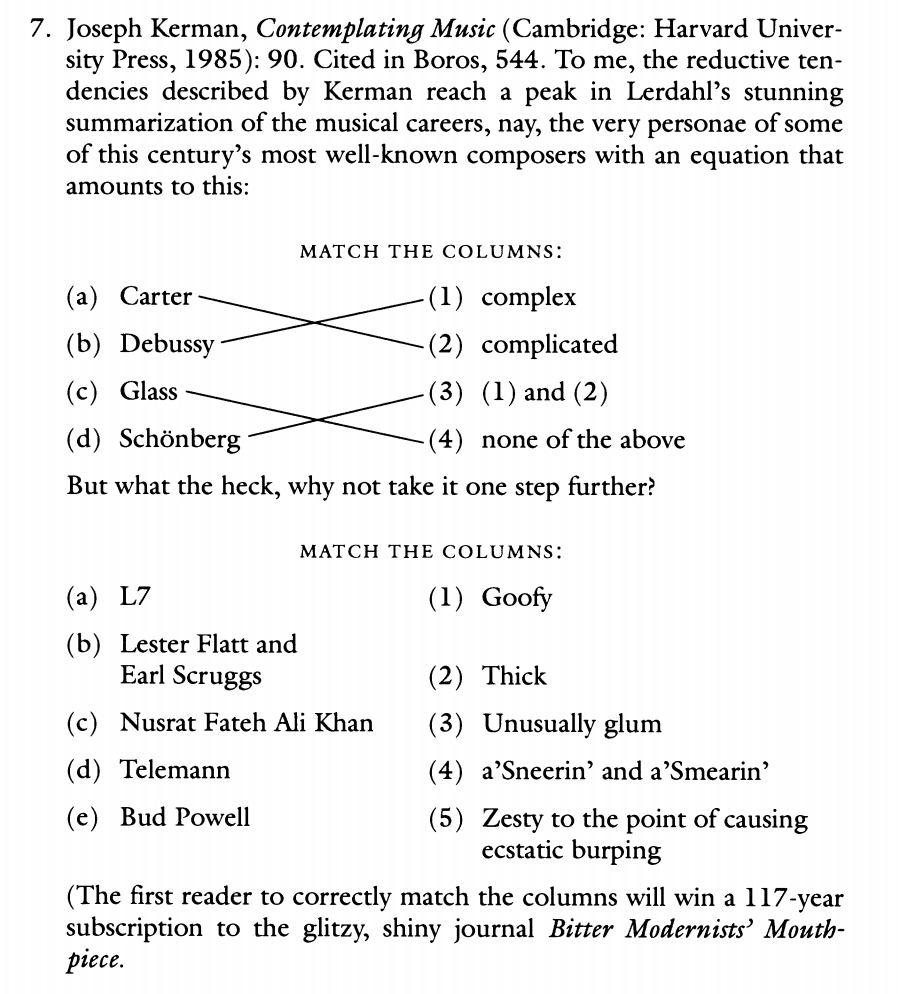
The last entry in the correspondence finds Boros no less adamant in his opposition, but apparently in a better mood for having annoyed Lerdahl. He notes that “hunkered modernist stance” would be a great name for a band. He proudly compiles a list of the various chastisements for rudeness directed at him throughout Lerdahl’s response. He even turns Lerdahl’s pronouncement that “Debussy is complex, Carter is complicated, Schonberg is both, and Glass is neither” into a matching game in the endnotes. Otherwise, Boros mostly sticks to his initial arguments. But he does make a strong case that Lerdahl still hasn’t resolved or even accurately characterized these objections.   

Final Thoughts

If there’s something unsatisfying about this conversation, it’s the scale on which Lerdahl’s ideas are evaluated. The screen is always zoomed out to the max, in a grandiose effort to take in humanity as a whole—and never zoomed in on the duelists themselves. It’s not really their fault, so much as it is a limitation of the conventions of academic discourse.

In this respect, Lerdahl is simultaneously the more at fault and the less frustrating of the two. His ostensibly universal rules at least give some indication of how he personally hears music. I doubt he'd be proselytizing about these ideas if he didn’t find them intuitively correct. By his own admission, he’s laying his aesthetic cards on the table. Boros—for all his anger at the reduction of “something as rich, complex, and personal as music to convenient graphical and verbal representations”—gives us very little sense of what goes on in his mind when he listens to music. There’s the occasional vague allusion to “body-oriented ways of coming to grips with music” and so on. But Boros seems to recognize that if you want to laugh at the cards someone’s put on the table, it’s safer to avoid showing your own. It might turn out that yours aren’t any better.

Since I’m not an academic, I can just admit it: I don’t care in the slightest if Lerdahl’s rules are supported by the latest studies or not. All I really care about is whether or not they’re supported by my own experiences. It’s nice being a random person, not having to agonize about whether ideas like the ones in “Cognitive Constraints” are truly universal or not—unlike those academics who carry the weight of the world on their shoulders. 

Maybe the most honest inward-looking assessment of music’s outer limits I’ve read came from the aforementioned Kyle Gann. In another blog post, he talks about his formative experiences with early modernist classics like “Concord Sonata” and Rite of Spring, describing how these intimidating works gradually opened up to him over many listens. He describes coming to appreciate both their macro-effects and their wealth of fleeting, magical details. But on Lerdahl’s whipping boy, “Le Marteau sans maître”, he has this to say:

In youth I attacked that piece with all the fanaticism of a new convert: read Musique aujourd-hui (of which Boulez eventually autographed my copy for me), did what analysis I could, and even did an independent tutorial learning to conduct the piece. But here again, I eventually came back to the piece in the late 1980s and realized that, after so many years of devotion, I couldn't meaningfully tell one movement from another, aside from the instrumentation. If someone had come out with a recording of Le marteau with half the pitches transposed by half-steps one way or the other, I wouldn't have been able to tell the difference. (I also analyzed every note of the Boulez Second Sonata before hearing it, and was so brainwashed that, when I finally heard it, I cried over its beauty. Today I wouldn't recognize that piece in a blindfold test.)

It’s the last part, ironically buried in parentheses, that most strikingly conveys the point. Unlike the comparatively traditional works mentioned, “Le marteau” and "Second Sonata" never opened up as listening experiences—even with Gann pouring maximum intellectual and emotional investment into them. The full post makes it clear that Gann hears more in high modernist works like “Le Marteau” than 99.999% of the population would, and considers a few of these works masterpieces. But while Gann probably wouldn’t agree with every point, I don’t think he’d sneer at Lerdahl’s basic angle of criticism. In fact, I think his devotion to the music in question would be the exact reason he’d take it seriously. 

Let me put my cards on the table. I think some of Lerdahl’s constraints very accurately describe how I listen to music. Or rather, how I best listen to music. How I hear things when I’m really in. I don’t know Lerdahl’s ideas by heart, but the first few "constraints on event sequences" have really stuck with me. Particularly enlightening is his starting idea of "discretization"—according to which “the musical surface must be capable of being parsed into a sequence of discrete events”. It reminds me of something Kit Mackintosh told me, that as a jazz instrumentalist he’d been taught to contain every phrase within a breath when improvising melodies. This basic principle can be applied on a very small scale (like that of individual "breaths") but also on a large scale. In fact, Lerdahl's next constraint clarifies that this process is "hierarchical"—meaning that each event is comprised of several constituent sub-events, with this process applying across multiple levels. To approach it visually, discretization just entails this sort of labelling:

 
But when it's applied hierarchically, i.e. on multiple levels, the best visual representation would be a sort of tree: 

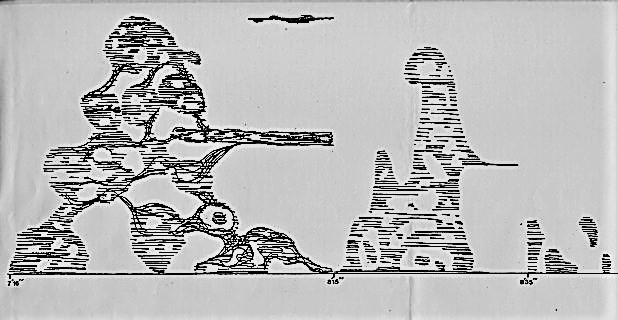
While it's easy to apply this listening technique to music organized according to the structures of traditional sheet music notation, it's less compatible with music derived from a score like this:

sure, it looks cool... but what AURAL forms are created by these visual ones?
Just as we need to separate speech into words, clauses, sentences, etc. to make sense of them, I do feel as though I have to be able to separate music into roughly equivalent structures to fully appreciate it.

If you've never explored the outer limits, this stuff probably won’t strike you as profound, because you've always been able to take it for granted. But if, like me, you’ve spent a lot of time listening to overedited IDM, babbling computer music, mercurial drone, and the like—wondering why you’re spacing out instead of absorbed—you may understand. Navigation principles are boring until you’ve been lost at sea. It’s all the countless moments of frustration I’ve felt listening to “difficult” music over the years that really vindicate Lerdahl. Looking back, the frustration has almost always come from being unable to parse a specific moment of music. I’m not bothered by unorthodox aural forms, I’m bothered when I can’t make out the forms in the first place. 

If you think of “Cognitive Constraints” as an index of navigation techniques, it becomes interesting that the angle of Lerdahl’s opponents always seems to be: “it’s actually just fine that avant garde music doesn’t follow your rules”. It’s always his premises that are questioned, never his application of them. But how many works in the vast array of music implicated in Lerdahl's critique are more compatible with these constraints than everyone seems to assume? In particular, what if his “constraints on event sequences” that I find so helpful are actually applicable to a lot of avant garde electronic music? 

(For example: around when “Cognitive Constraints” was first published, Francois Bayle was making points similar to Lerdahl. In “Image-of-sound, or i-sound: Metaphor/metaform” he writes that “the way in which the audible is segmented should be taken into consideration . . . correctly segmenting means correctly depicting”—directly aligning with Lerdahl’s principle of discretization. Certainly, Bayle seems to have applied this constraint to his own compositions from the same time: in an analysis of Bayle's 1988 work “Théâtre d'Ombres” Stéphane Roy borrows a method of analyzing the shapes of tonal melodies to parse its aural structures. If the director of Europe’s most uncompromisingly modernist electronic music studio was in such close agreement with Lerdahl, maybe Lerdahl’s critics shouldn’t have been so quick to dismiss his ideas as myopic impositions.)

In an article titled “Does Nature Call the Tune?” the critic Richard Taruskin weighs in on the European Serialist vs. American Tonalist debate. To the former, Taruskin credits “an attractive optimism about human adaptability” while to the latter he attributes a “gentle pessimism” about our listening capabilities.** He’s right. Despite the outward projections of cynicism, it's the European serialist who’s a wide-eyed optimist at heart, who believes that we can genuinely love even the most unorthodox aesthetic outcomes, who guards the assumption that anything is possible. And it's the American tonalist who’s pessimistic, who believes the future can only arrive through major compromise. This pessimism isn't born of out apathy, however. It’s born out of caring too much. An unwillingness to overlook musical shortcomings when one notices them. Refusing either perspective entirely would be to lose a critical part of ourselves. So maybe we ought study navigation techniques like those provided Lerdahl. And then use them to try and sail as far as we possibly can. Past where they're supposed to stop working.

* Boros, it turns out, actually mentions that he's American. But he also delivered the first edition of the paper in question at Darmstadt—a place which needs no introduction if you're versed at all in 20th century classical music history. In other words he's spiritually European

** Taruskin concludes he prefers the American tonalist attitude. As a critic who came of age during the Cold War, in a climate where works like "Le Marteau" were hailed as the gold standard of innovation, it makes sense that he'd feel that way. That's the thing about critics: they (we) are just as much products of their time as artists.